
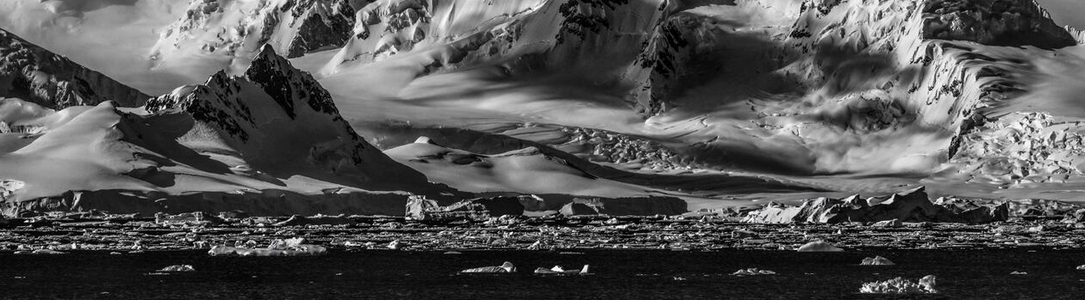
Photo credit: Neil Ever Osborne [o]
OBSERVATION
I wasn't the first to stand like this and listen. Frank Hurley, photographer on Mawson's 1911 expedition, wrote about it in his field diary: that the sound seemed to have frozen. Admiral Richard Byrd as well, alone for five winter months in a small hut, twenty years later.
Evening. Everyone went inside, I went out. We were in Neumayer Channel, named by German explorers on an expedition in 1873. The deck was empty, only the soft surface underfoot and my footsteps, which I heard more clearly than I expected. I heard the friction of my jacket and thought: wind. But there was no wind. In this place, the cold had nothing to do with movement. It was simply the temperature of everything — the air, the water, the metal of railing — and how the utter stillness of this cold felt around me. There was nothing to push against because nothing was pushing.
They resembled the sounds of instruments, the crackling of a Geiger counter, the hiss of a screen when a television channel goes off the air . . .
The first thing that stopped me was the sight of the mountain peaks. Dark rock, and along the very edge, white snow. As if someone had outlined them in white on black — snow below, white as clean paper, and dark above. I was used to mountains whitening from the top. Here it was the other way around.
The water beneath the hull was black and completely still. Not dark blue, the way cold latitudes usually look, but black like oil poured between mountains. The ice floes in it were pure white, without a trace of blue, unlike other places where the ice runs bluish. Here it is absolute white. The mountains reflected in the water sharply and cleanly, merging with nothing. A black mirror holding an exact copy of a black-and-white world.
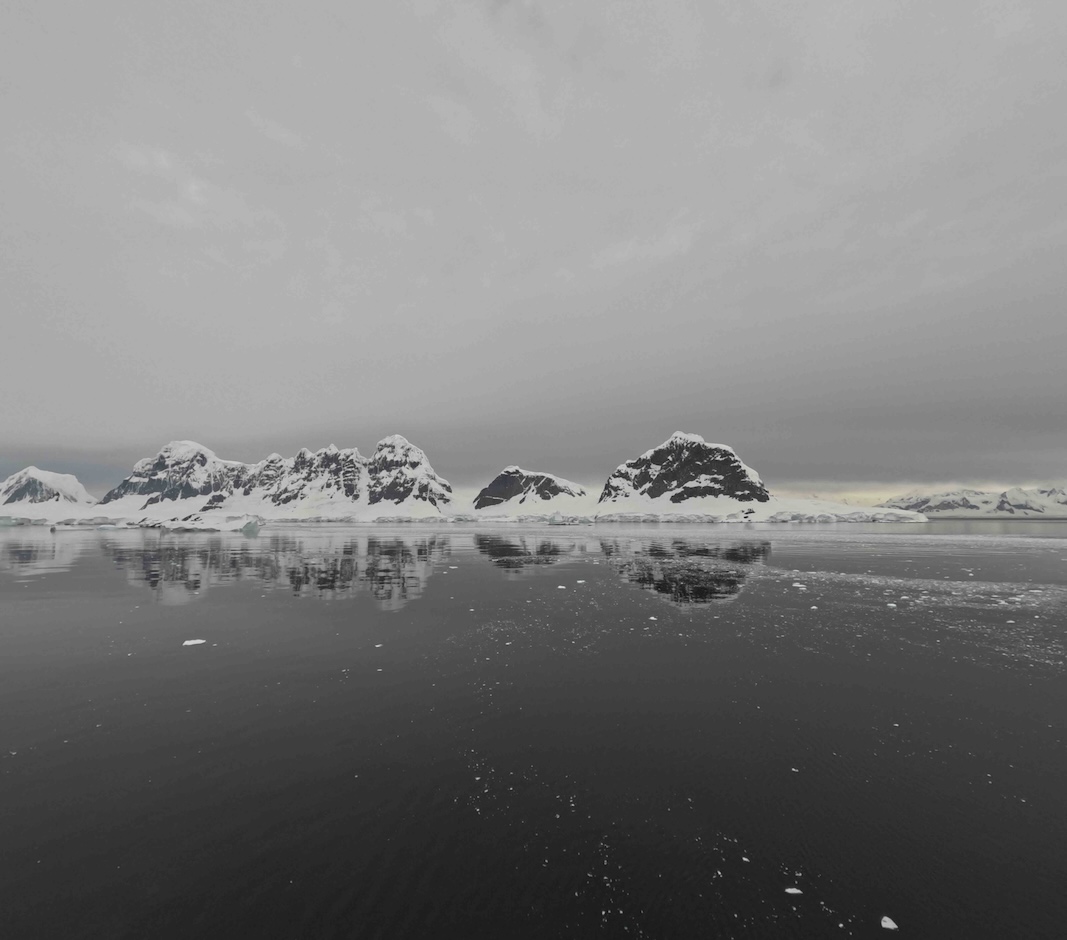
The sky was sealed under a dense grey haze — not fog, the fog hadn't dropped — just thick, opaque sky. The space around was closed: mountains on all sides, a narrow channel, the ship almost motionless. Like being inside a barrel.
Then I noticed the sounds.
The sounds were only low. No detectable high frequency, only dull impacts of water against the hull. Not slaps but something dense, coming from within. Again, no upper register, only depth. A faint crackling without a source, like the crackling of coral and molluscs when you dive to ten metres and the reef around you is alive. Except I was standing on a deck. The engine's vibration — not a sound but a pressure: felt not in the ears but in the body. Like being far from a motor underwater and sensing it not through hearing.
I was standing in air yet everything sounded as if underwater. These were not natural sounds. They resembled the sounds of instruments, the crackling of a Geiger counter, the hiss of a screen when a television channel goes off the air and the picture dissolves into black-and-white noise. Nature here did not sound like nature. The picture around me was the same — black, white, grey, only that — but it was as if I was on two channels at once. It made it difficult to look and listen at the same time, and not because I didn't want to. The environment wouldn't allow it. When I looked, the sounds receded. When I listened, the image stopped existing. I chose to listen and stopped moving.
I leaned against the railing, not for support but just for a light touch to avoid creating any extra movement. I narrowed my eyes and tucked my hands into fists. The cold interfered with listening, it distracted. I reduced my breathing. It seemed to me that even the way my face was slowly freezing was getting in the way of distinguishing the sounds. I wanted to switch off everything except hearing.
I tried to separate the sounds. To isolate each one, I listened harder but they merged harder. Not disappeared, but merged into a uniform low presence with no source and no direction. The more precisely I tried to catch one sound, the more tightly they closed around it. I understood that sounds were there. I couldn't catch a single one. It was frustrating. The breathing was in the way, the clothing was in the way. My fists were clenched to keep the cold from distracting me. Antarctica was sounding and I was louder, alone on an empty deck trying to hear what wouldn't give itself. The harder I tried, the quieter everything seemed to get.
I stood, restricting my breath. Rather than space expanding or contracting, it felt distorted — like a stretched rubber sheet with a heavy ball at the centre and I was that ball. The water near the hull, the nearest mountain slopes — all of it softly curved around me. Things in the distance — peaks, sky, the far shore — stood flat and still.
Fists clenched, breathing just enough, I looked at the black water and listened to what I didn't know how to hear.
REFLECTION
Further diary notes by Frank Hurley were that the wind had dropped and the silence began to feel like a substance. Voices sounded strange. Hurley searched for familiar sounds — insects, birds — and found nothing.
Richard Byrd spent an Antarctic winter alone on the Ross Ice Shelf. He listened . . . to nothing . . . to the excitement of the silence itself. The quiet was so complete it became active. Charles Laseron, a member of the same expedition, described the moment the wind suddenly dropped: the eardrums began to throb as though from a great noise. The silence pressed on the ears like sound.
All three described the same thing — the absence of sound. The environment had gone quiet and that quiet pressed down.
I did have sounds. Antarctica was not quiet. It was full of low, muffled, technical sounds, and those sounds were precisely what merged into silence. Not emptiness generating silence, but a kind of fullness — sounds that couldn't be separated, caught, named. That is a different phenomenon.
In Alaska it was the other way around. I had watched the Northern Lights in different places: Norway, Iceland, even Belarus, my country. But I heard them only once, in Alaska.
That night I was lying in my cabin when the phone vibrated. The app showed a high probability of solar activity, very strong for several days. In Alaska, a clear sky at that time of year is rare, yet for the first time in awhile the sky was clear. I dressed and went to the upper deck — to the crew area, less artificial light. Walking along the deck I saw a greenish glow on the horizon and I knew: it's there. I just had to wait.
I stood at the extreme edge of the stern, leaning against the railing. The air was still and pleasantly cool, not like the intrusion of acute heat or cold that the body refuses to merge with. My eyes began to adjust to the darkness and the silhouettes of mountains appeared in the distance as shadows. The first waves rolled through and disappeared. Directly above me a wall of hanging curtains began to expand — columns of light that streamed downward. I wasn't looking forward. I was looking up. Like a piece if thin silk thrown into the air, the wave travelled up and rippled overhead. Greenish passing into reddish into violet, just a short distance above me.

In my voyages I have a many kinds of different light. Rainbows in fjords, up there so close! Rainbows double and triple that chased the ship. Rays of light travelling underwater that appeared physical, tangible, contactable. Light you want, and feel you can, touch — because it appears to be matter. I reached out my hand to the silk ribbon on a current of air — drifting and rippling — and understood what I couldn't reach.
The Sami named the Northern Lights guovssahas: “the light you can hear.” It’s not a metaphor, it’s a name. The Inuit believed that if you whistled at the aurora it would come down lower. For me that night it descended on its own.
In Antarctica I had contracted or been contracted. I narrowed my eyes, stopped my breathing, hid my hands in clenched fists. Doing what I could to remove myself from the environment so I could hear properly, the body opened, the eyes widened, the face relaxed and the hands felt the urge to reach the light. Even the muscles of my face felt different. It was stillness without tension. It was the stillness of wonder.
Then out of the silence, a sound began to grow. Not at once. Gradually. A hissing, a crackling, like static electricity — but more dense, more sustained. Not loud. Dense and continuous.
I went still again, not from frustration as in Antarctica but from being afraid to move and make a foreign sound, afraid of interfering with what was happening. When a melody starts playing in your head, it’s there but you don't hear it. It's pleasant and you're afraid of losing it, afraid it'll fade and you'll forget it. Or a good dream. You wake up and you want to fall asleep again to bring the dream back. If you can’t get it back tpo it you regret losing it. I knew there couldn't physically be sound, that I wasn't actually hearing it. The sound I was hearing while looking at this glorious bright image was an illusion, my imagination’s accompaniment to it that I was afraid of losing.
§
Antarctica was full of sounds, the Northern Lights were silent. I heard silence where there was none, I heard sound where there should have been none. Whether I can be trusted as a witness, I don't know. But I know one thing for certain: what I perceived was real. And it did not always coincide with what was actually there.
The water was a black mirror and it reflected the mountains precisely. But my perception altered the picture. My brain distorted and changed the information around me. Looking at the Northern Lights, my brain built something new. My perception destroys and builds the world around me. ō

ALIAKSANDR ZHERDZEU is a marine professional who was born in Belarus. He has worked for fourteen years at sea on five oceans and docking at more than a hundred countries. Before the ships, he spent years training his body to listen: balance, weight, the language of movement. His native languages are Belarusian, Russian and a dialect of Ukrainian. Aliaksandr lives in Lopatino, near Pinsk in Belarusian Polesie, close to the Ukrainian border.
Photographs by the author except top photo (credited) and Northern Lights, Reuters.
Add new comment