
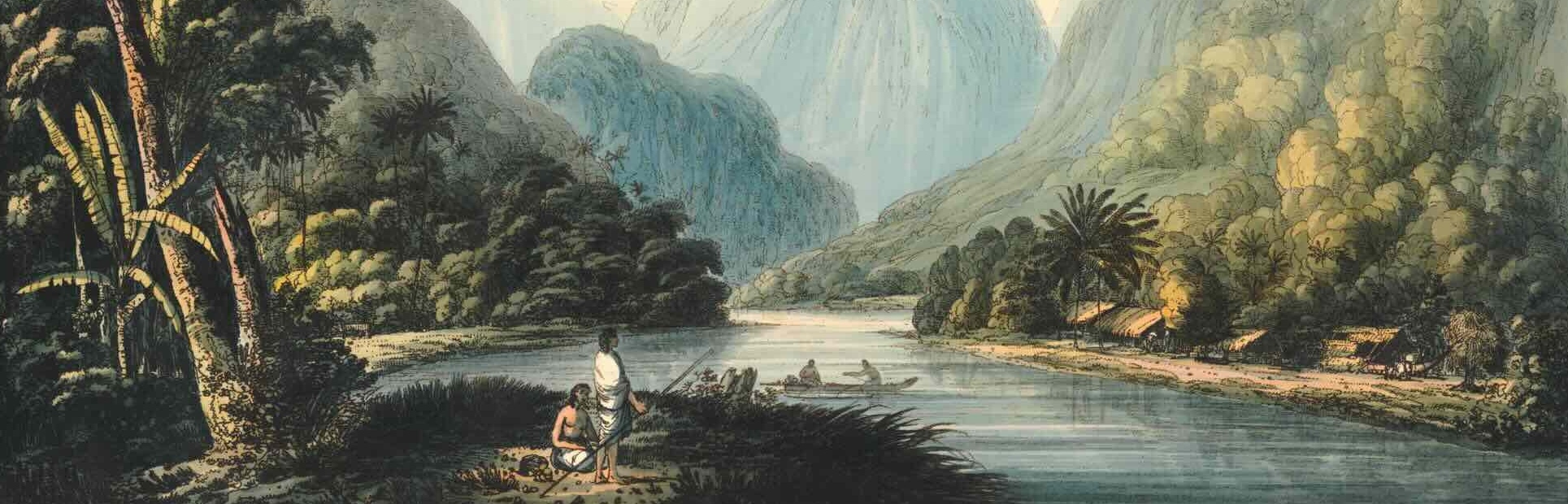
Oheitepha Bay, island of Otaheite. Painting by John Webber, an artist on Cook's third voyage in the Pacific.
AUTHOR'S NOTE
Mainstream accounts of James Cook are still dominated by old school history, written by white male apologists for the realpolitik of whatever era they are writing about. “Tales of the European discovery are still shaped by imperial attitudes; and accounts of the great voyages of exploration are often written as epics in which only the Europeans are real… The way they [the local inhabitants] were understood was monocular”.1 In my research for this series of essays on Cook’s voyages in the Pacific, I have used the work of scholars who combine history with anthropology, in other words: a two-sided approach that interweaves the deep cultural inquiry of anthropology with the historical interpretation of primary source material. By digging into both the standard accounts and the newer critical thinking, I have tried to bring that anthropological-historical approach to bear on this stubbornly enigmatic material.
She was a floating island, a mythic bird, a bad water spirit; a sand crab, a nest of goblins…. Gliding over the water like a huge canoe with a tree sprouting clouds; a giant pelican crewed by possums.
— Peter Moore, Endeavour: The Ship That Changed the World
The first essay of this series, 'Cultural Exchange Through Objects,' showed how Cook's early experience at sea prepared him to become a gifted captain and one of the greatest navigators in European history. The piece looked briefly at his three epic voyages in the Pacific, then applied some close scrutiny to a selection of indigenous artefacts, illustrations and relics from Cook’s travels. Part two of this three-part series takes a fresh look at Cook’s engagement with the indigenous peoples of the Pacific, specifically the natives Tahiti and New Zealand. On the first voyage, Cook and Joseph Banks, the wealthy young delegate of the Royal Society who helped to fund the expedition, envisioned themselves as emissaries of the Enlightenment. In their relations with the native peoples of Oceania, however, their enlightenment only got them so far. This was never more evident than in the story of Tupaia, the Polynesian priest who joined Cook’s expedition in Tahiti.
Cook arrived at Tahiti on 11 April 1769 to observe the Transit of Venus. It was not just a good place to see the planet Venus in action; it was also a favourite island of Venus the goddess of love. Previous visitors, Samuel Wallis in HMS Dolphin and then the Frenchman Louis Antoine de Bougainville, had shared dreamy images of Otaheite that inflamed the imaginations of Cook’s crewmen long before they landed. When Bougainville sailed from Tahiti in April 1768 he wrote in his journal: “Farewell happy and wise people, may you always remain what you are. I shall never recall without a sense of delight the brief time I spent among you and, as long as I live, I shall celebrate the happy island of Cythera. It is the new Utopia.” On landing a year later, Joseph Banks declared: “The scene we saw was the truest picture of an arcadia of which we were going to be kings...” 2
Tahitians understood the arrival of the European visitors as fulfillment of an ancient prophecy, that their ancestors would return to the islands.
Tupaia, this Tahitian whose fate was to become an essential part of Cook’s story, was a high priest of ‘Oro, the god of fertility and war. He was also a member of an elite group of Polynesian knowledge keepers, the ’arioi, travelling performers and ceremonial teachers. In addition to his deep understanding and care for the wisdom traditions of his culture, he was an adept star navigator who had travelled many hundreds of miles of blue water sailing to perform ‘arioi ceremonies on many islands in Polynesia. Later commentators would call him a polymath, a genius and a shaman. At the time of Cook’s arrival, he was a refugee from an invasion of his home island of Ra’iatea, the most important ceremonial centre and ground of ancestral mythopraxis in all of Polynesia, remembered and worshipped even by the distant Māori of New Zealand.
Tupaia came on board the HMS Endeavour as part of the retinue of the high chief Tuteha, who had recently emerged victorious from a bloody conflict that deposed ‘queen’ Purea. She was the ambitious woman that Wallis (who ‘discovered’ and ‘claimed’ Tahiti in 1767) had wrongly assumed to be the queen of Otaheite. This detail is complicated but important to understand; as her right-hand advisor and lover, Tupaia had been elevated by Purea (also known as Oborea) to be the most important high priest (tuhana) on the island. Yet two years later when Cook and Banks met him, he was experiencing a period of insecurity and political vulnerability and consequently seeking new ways to restore his status.
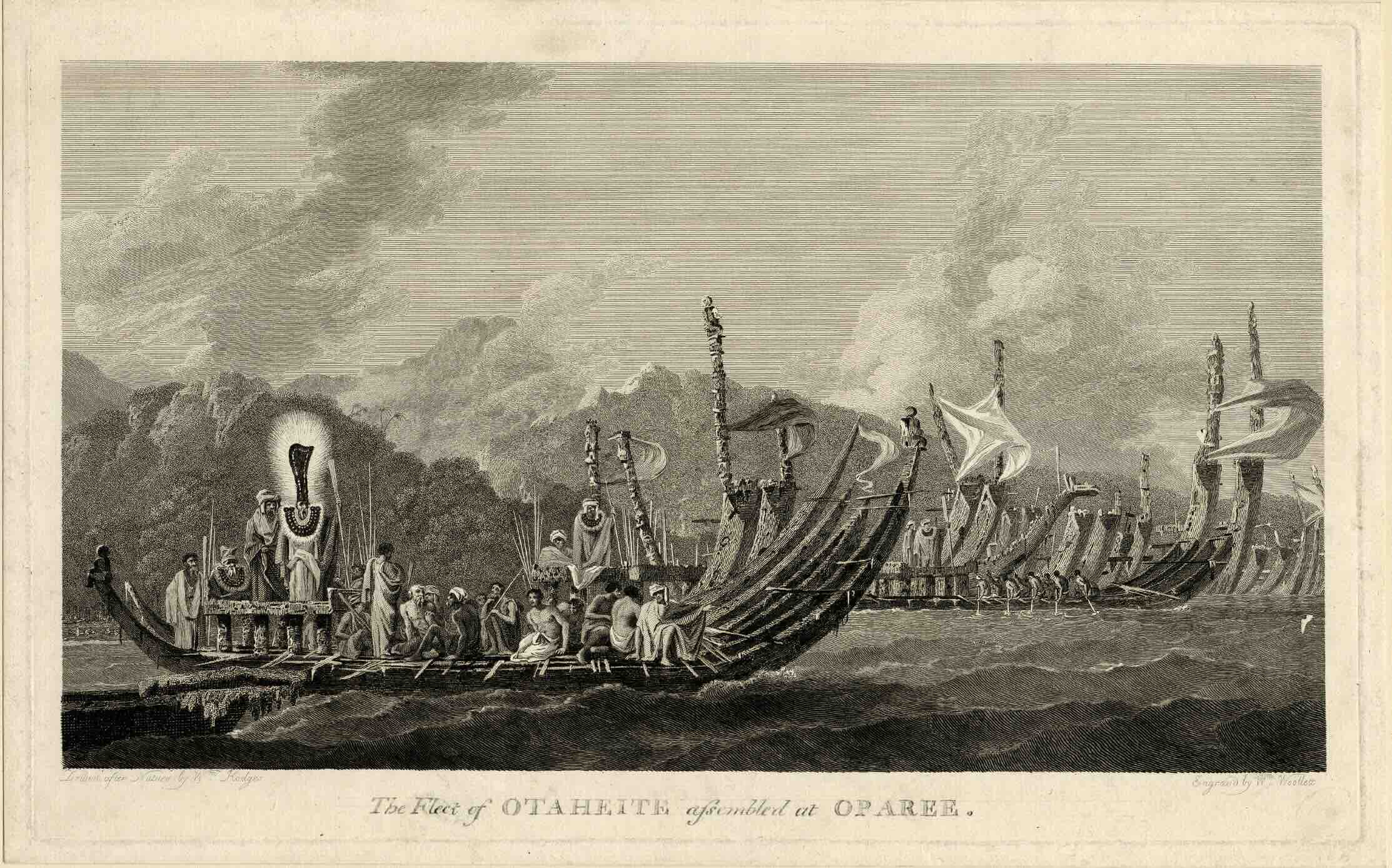
The Fleet of Otaheite assembled at Oparee, Willam Hodges 1773. Illustration of 'A Voyage towards the South Pole ... in the years 1772-
75'. On the boat in the foreground is a figure in mourner's dress.
Tupaia impressed Cook immediately with his diplomatic bearing and willingness to share information with the powerful strangers. Banks soon adopted him as his companion and advisor on Tahitian customs, and they went everywhere together. At the same time, Purea was still a force to be reckoned with; before long she had Banks in her bed. In an incident that Banks recorded in his journal, he was robbed of some possessions in flagrante delicto. Cook and his companions never understood that among Polynesians theft was ambivalent and the notion of property ownership was fluid. As in ancient Greece, there was a Tahitian god of thieves, a shapeshifter — playful, clever and quick. Stealing was a constant problem, and Cook was inconsistent in his response to it. In fact natives were killed due to misunderstandings and overreaction; Cook’s men killed a man in the Marquesas for stealing a penny nail. “The image of young Banks crying ‘thief’ in the middle of the night for the loss of his silver-frogged waistcoat and pistol while he lay naked bedside his ‘old friend Oberea’ on her double canoe was a gift beyond price for the satirist.”3 The published account became famously a part of English popular culture. Purea’s tattoos — her ‘pinked bum’, or ‘painted breech’ — were immortalized in poems and doggerel.
Yet for Purea, as for all the girls and women of Tahiti, sex had a whole other order of meaning that was incomprehensible to Cook’s men. While for the crew, sex was a basic drive, for Tahitians it was “the sacred force that drove the cosmos, ensuring the continuity and well-being of descent lines and providing people with key resources”.4 Tahitians understood the arrival of the European visitors as fulfillment of an ancient prophecy, that their ancestors would return to the islands. Women and girls were sent out to the ships in submission to beings perceived as ancestral gods. While the Tahitians soon realized the visitors were human, they were still seen as extraordinary. They continued to make special bond (taio) relationships to join their spirits (varua) with their visitors.
The sailors grew so fond of Tahiti and their native paramours that they inscribed their allegiance on their bodies. In our heavily tattooed urban hipster culture, many may be unaware that tattoo (tatau) is a Polynesian word. After the famous mutiny on the HMS Bounty, all the mutineers got tattoos, as had many of Cook’s crew before them. Fletcher Christian, the leader of the mutiny (played in films by Clark Gable in 1935 and Marlon Brando in 1962) had a tattoo banded across his buttocks and a cheeky star of the Order of the Garter on his chest.
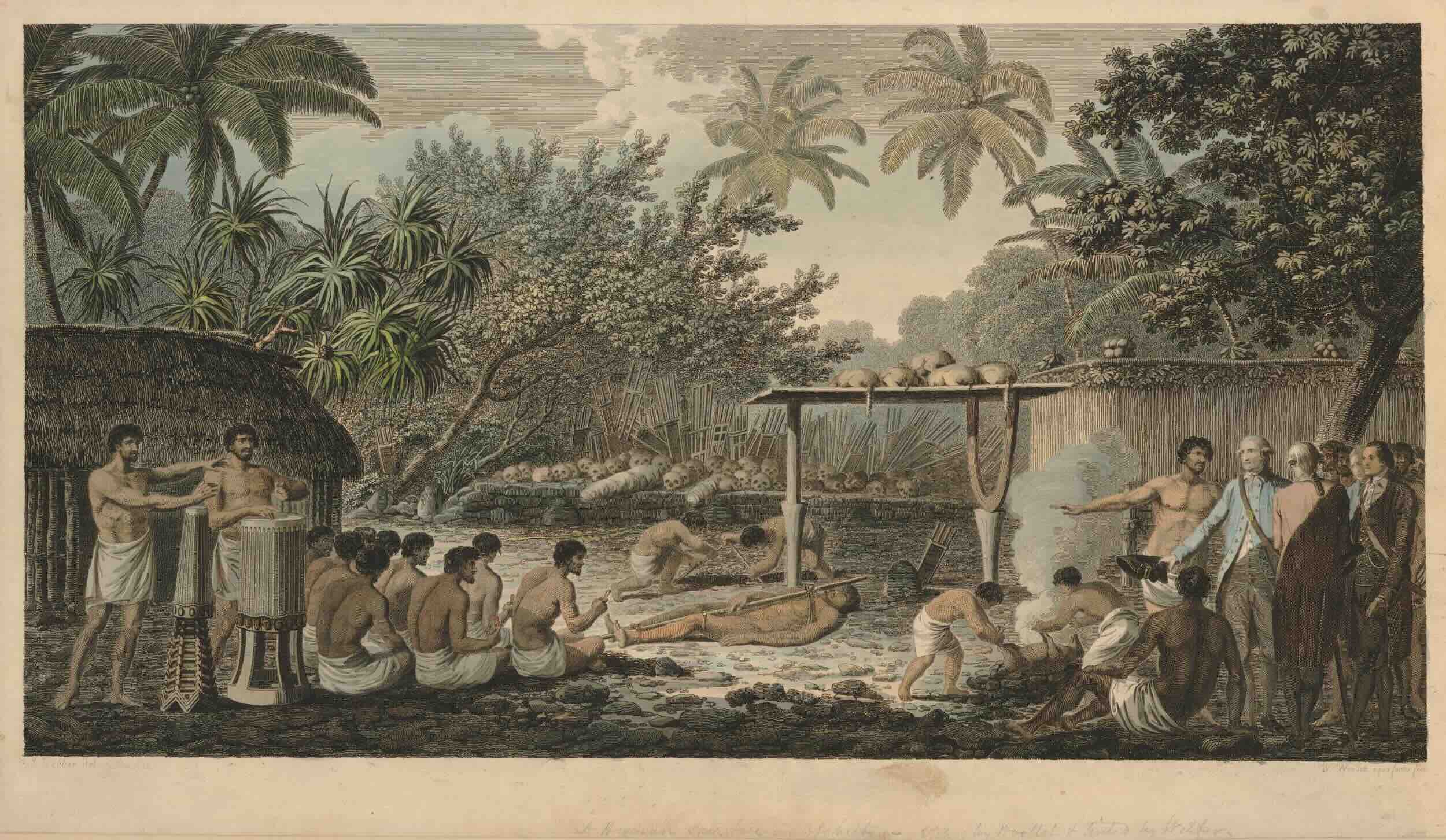
“A Human Sacrifice, in a Morai, in Otaheite” John Webber, 1777. Preparations for a human sacrifice watched by Captain Cook and others from the expedition on Cook’s third voyage.
Tahiti in 1769 was a place of erotic opportunity and voluptuous leisure. It was also a place of sacrifice: violence on the one hand and communion on the other. Tupaia, as a high priest, was an important actor in this perennial aspect of Tahitian life, death and cosmology. “The debris of sacrifice — skulls, and bones and corpses — was everywhere to be seen and smelled.”5 Cook and Banks pursued their ethnographic curiosity to become eager participant-observers of sacrifice. As beings considered to be sent by the gods, they were incorporated into the ceremonies more than they knew.
Cook described Tupaia as “a very intelligent person and to know more of the Geography of the islands situated in these seas, their produce and the religion laws and customs of the inhabitants than any one we had met with.”6 Detailed descriptions of Tahitian customs in the journals of Cook and Banks are likely based on conversations with Tupaia. “Although we don't know what Tupaia looked like, it's possible that one of Sydney Parkinson's unnamed portraits is of him. We do know that he had black tattoos on his legs, from thigh to heel, marking him as a high-ranking member of the 'Arioi cult”.7
Cook’s ethnographic curiosity was always pragmatic, gathering information for his immediate needs and the mercantile interest of the Crown (‘produce’, first and foremost). He was aware of the seismic cultural disturbance that his visits caused, but his empathy was limited and his regret muted. Despite the opportunity for deeper understanding afforded by his relationship with Tupaia, Cook became convinced of the superficiality of native beliefs. He was “scandalized that, in awesome circumstances, the Tahitian priests played distracted, careless roles, showing the distance between the words they spoke and the meanings they extracted from them”.8 Observing what he perceived as the casual indifference of Tahitians to rituals and sacrifice, Cook failed to appreciate the degree to which cycles of ceremony and reverence infused every aspect of their daily lives. It can be argued that his skeptical, secular rational bias made him blind to the authenticity of native spiritual practices involving life and death — and the immanent presence of the numinous in their everyday lives. This failure, which Banks shared to a lesser degree even as he forged a taio bond with the high priest Tupaia, would be problematic later when Tupaia joined the expedition and left his home islands behind.
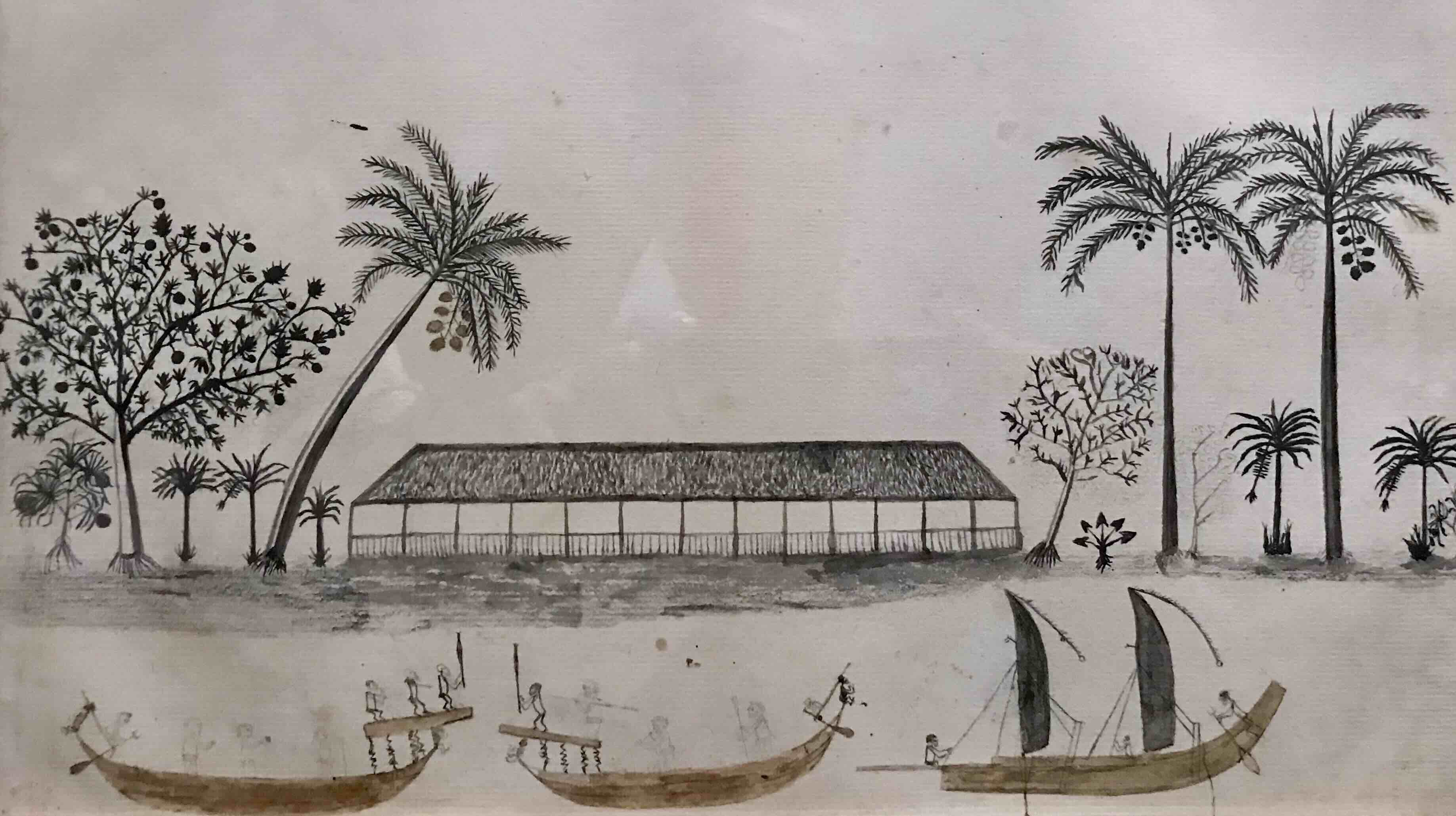
A scene in Tahiti, Tupaia 1769. This is an illustration of Tahitian life that may have evolved in conversation with Banks. It shows staple food crops including pandanus, breadfruit, coconut, banana and taro, a longhouse, and in the foreground both a sailing canoe and two war canoes with men fighting in the ritualized style of a Tahitian sea battle.
In all Cook’s encounters with native peoples, there was mutual human recognition, and yet incomprehension on both sides. He and his crew were 18th century Europeans who could not understand who Tupaia was, and it is also clear that Tupaia failed to grasp the limitations and risks he faced in setting out on the vast sacred marae of the ocean with these strange men for whom it was just water. They lacked the cross-cultural breadth of mind and intuition necessary to appreciate what Marshall Sahlins calls “cultures of immanence” in which spirits, ancestors and gods have not left the earth, where “people are but a small part of an enchanted universe misconstrued by the transcendent categories of ‘religion’ and the ‘supernatural’.” 9
The Endeavour remained in Tahiti for three months to successfully complete astronomical observations for the Royal Society. As they prepared to leave, Banks proposed that Tupaia ought to accompany them, and Tupaia expressed a desire to visit England. Cook was skeptical, worried about the cost of looking after him. Banks offered to pay for the expense of bringing his friend Tupaia on board, along with his apprentice, a boy of about 12 years-old named Taiato.
With startling arrogance, Banks mused in his journal about how interesting it would be to have Tupaia to converse with on the journey. “I do not know why I may not keep him as a curiosity, as well as some of my neighbours do lions and tigers at a larger expence than he will probably ever put me to.”10 He well knew that Tupaia had been a distinguished person of high rank, but perhaps the fact that Banks’ patronage was useful to this defeated Tahitian nobleman caused him and Cook to view Tupaia with some condescension.
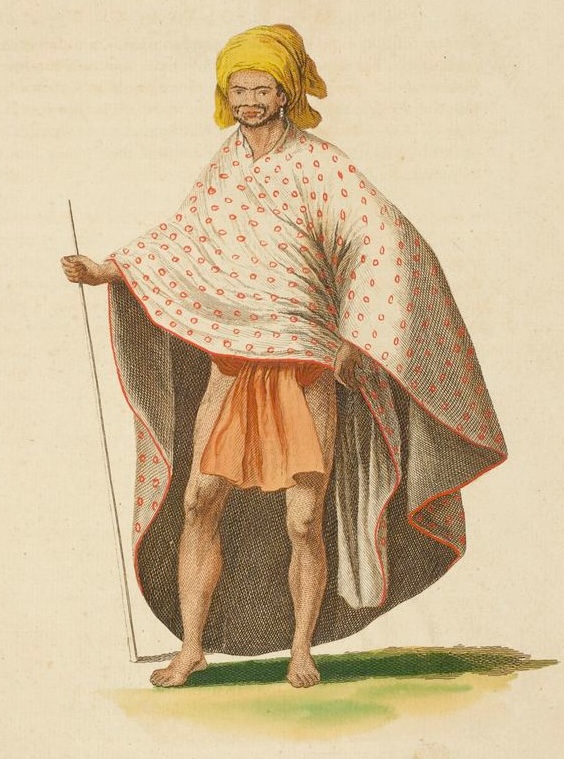
This engraving of Sydney Parkinson’s drawing of a native Tahitian man appeared in Parkinson’s posthumous 1773 book, ‘A Journal of a Voyage to the South Seas, in His Majesty’s Ship the Endeavour’. Though unfortunately no pictures of Tupaia have been found, this gives a sense of simple Tahitian dress.
Nevertheless, they respected his obvious, if mysterious, navigational skill. Cook, along with his master Robert Molyneax, actually went so far as to trust Tupaia as their guide and ambassador. For several weeks Tupaia stood on the bridge and acted as the lead navigator on board the ‘wooden world’ of the ship. He piloted Cook and Endeavour through the reefs, shoals and sometimes hostile inhabitants of the Society Islands, enabling Cook to explore this uncharted region and to visit many distinct, interdependent societies without mishap. In a matter of weeks, Tupaia learned to sketch with pen and watercolour, making several images that for 250 years were attributed to Banks or one of his shipmates.
Despite their rare notes of praise and astonishment at his abilities, they did not give his knowledge traditions credence — as another kind of valid way of knowing. They saw him and all ‘natives’, ‘Indians’, or ‘Blacks’ through the lens of British and Christian cultural and racial triumphalism.
On the journey meandering among the Society islands, Tupaia taught Cook and Molyneux some principles of Polynesian navigation and dictated lists of more than 100 island names, islands many hundreds of miles from his home, which he and his forefathers had visited (though Cook remained skeptical about this claim). Working with Cook he created a remarkable chart of the Pacific, trying to explain his oceanic world to his fellow mariners. Despite this, the two men were at cross-purposes. While Cook “used instrumental measurements to fix the islands in Cartesian space, gridded by latitude and longitude, Tupaia was placing the islands in Polynesian space-time, with star, wind and human ancestors linked with particular people and places in expansive, dynamic kin networks.”11
Māori oral histories say that local people thought Endeavour was Tupaia’s and that the weird-looking goblin-creatures were under his command.
Though Cook never suggests in his journals that he asked Tupaia to explain how he navigated, he did acquire some idea of how he did it. He wrote that “In these Pahees [voyaging canoes] as they call them…these people sail in those seas from Island to Island for several hundred Leagues, the Sun serving them for a compass by day and the Moon and Stars by night”.12 However, this was only part or Tupaia’s art and science, which relied on sensitive powers of observation that had more in common, perhaps, with the intuitions of migrating sea turtles and whales than with European navigation techniques. For 200 years what Tupaia’s skill was misunderstood and thought to be inaccurate, but modern research has revealed how he translated his mental map of a relational universe onto a ‘chart’. Working on the map side by side with Cook, Tupaia was trying to integrate two contradictory mindsets — or rather, to make one intelligible in terms of the other. Tupaia
dwelt in the process itself: islands appeared on the horizon, or fell away astern as time unfolded, while in the heavens above, sun, moon and stars majestically followed their courses. All were bound together in a shifting web of relationships that extended to ancestors and to the gods. The wayfinder’s skill lay in experiencing and manipulating these known processes, while being attuned to the signs—from reflected colour on a cloud’s belly to the behaviour of sea swells—announcing all that lay ahead.13
Cook thought that several of the islands on Tupaia’s map were in the wrong place on his grid, but we now know that Tupaia’s map is based on arrays of bearings (and sometimes distances) between different sets of islands of departure and arrival around Tahiti. When island navigators set sail from an island "they knew the tides, currents and winds, the flight paths of birds, and the bearings to different islands of arrival, along with the sequences of stars (or ‘star paths’) that rose and set on the horizon on those bearings. All of this was taught in the navigation schools, along with the chants that summoned up various wind and star ancestors to guide them on their voyages”14
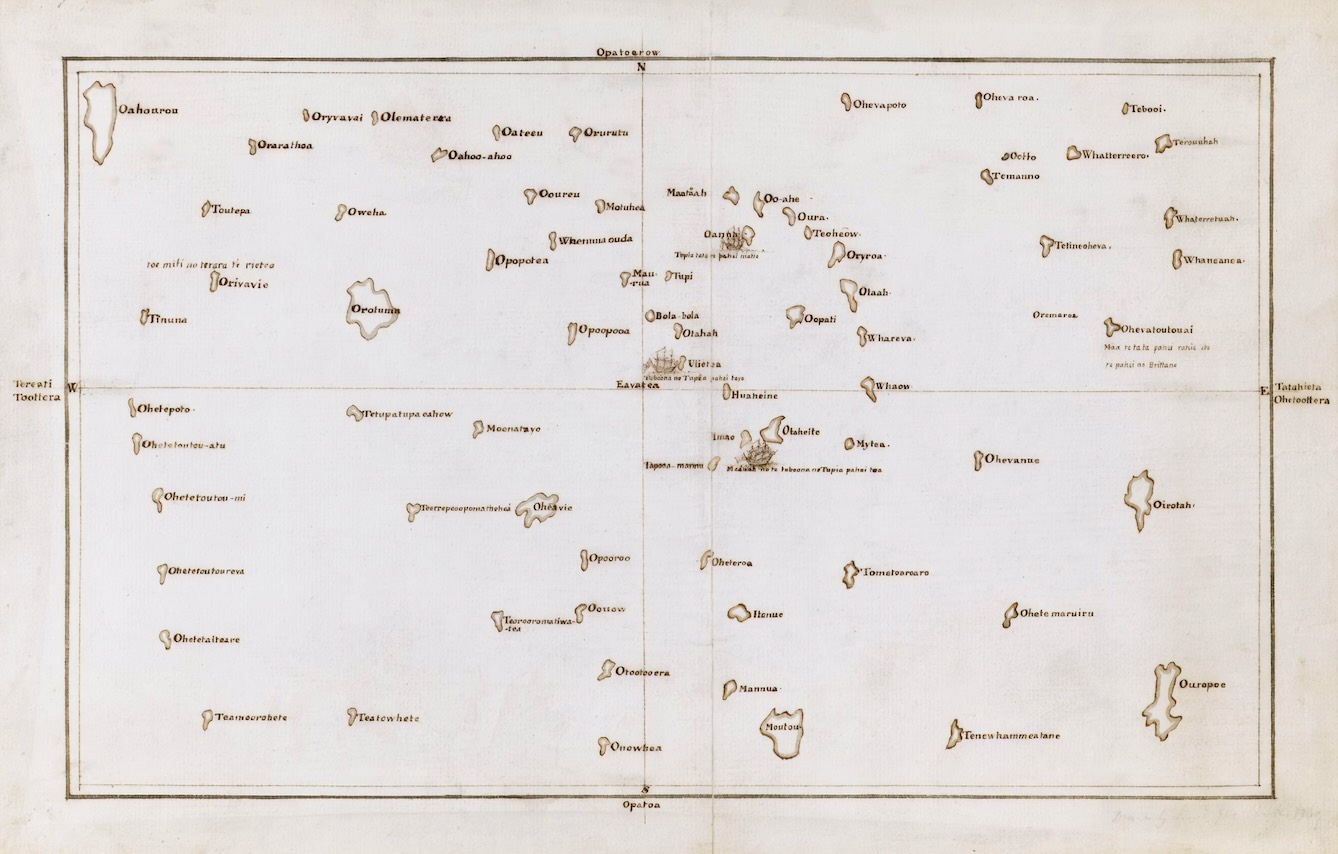
“Chart of the Society Islands with Otaheite in the center July-Aug 1769”. Chart showing the Pacific Islands, based on information provided by Tupaia. Attributed to James Cook, circa 1769-70.
Whatever Cook thought of his guest’s credibility, Tupaia’s geographical knowledge was vast, extending across nearly one third of the Pacific Ocean, from Tonga and Samoa in the West to the Marquesas and Tuamotus in the East. Tupaia assured Cook that if he continued to the west they would encounter many more islands, but Cook was intent on following his secret orders from the Admiralty: to venture forth in search of Terra Australis, the fabled southern continent. Cook and Molyneux no longer asked for Tupaia’s help. Becoming more and more disempowered, Tupaia settled into a melancholy state and rejected most of the unfamiliar, unpleasant dried or salted food that was offered to him.
As the officers paid less deference to Tupaia, the crew took the liberty of treating him badly. In his journal, the midshipman Joseph Maura wrote that
Toobia ... was a man of real genius, a priest of the first order, and an excellent artist: he was, however, by no means beloved by the Endeavour’s crew, being looked upon as proud and austere, extorting homage, which the sailors who thought themselves degraded by bending to an Indian, were very unwilling to pay, and preferring complaints against them on the most trivial occasions.”15
When Cook reached the latitude of 40 degrees without sighting any shore, he decided to go no further and headed west toward Aotearoa, the land that the dutchman Abel Tasman had named New Zealand, 127 years before. The Endeavour landed on the verdant east side of the North Island in Tūranganui-a-Kiwa which Cook named Poverty Bay. The Māori were hostile, and in the first two days five warriors including a chief were shot and killed. Tupaia got involved when some young fishermen were killed in a skirmish. When the survivors were brought on board the ship, the uniquely gifted communicator Tupaia was able to master the phonetic shifts necessary to understand what the Māori were saying (although later Tahitian visitors could not grasp the dialect). His willingness to serve as translator and mediator throughout this part of the voyage enabled Cook to avoid further bloodshed, trade for provisions and complete a 6-month circumnavigation and detailed mapping of the north and south islands of New Zealand. Māori oral histories say that local people thought Endeavour was Tupaia’s and that the weird-looking goblin-creatures were under his command.16 Tupaia also demonstrated his importance to the Māori by appearing on deck at times dressed in frock coat and breaches.
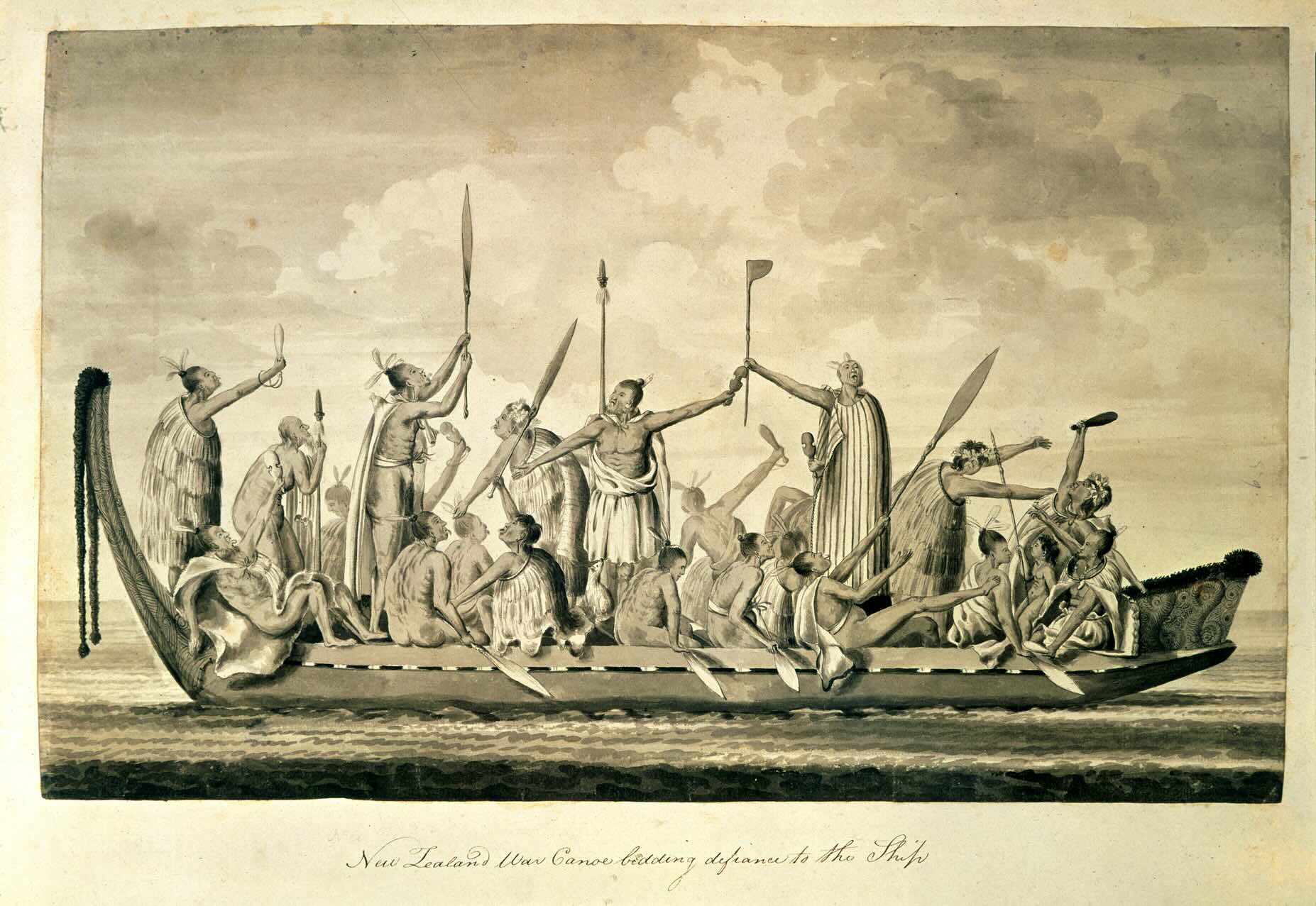
New Zealand war canoe (waka taua) bidding defiance to the ship. The canoe has a high prow, and elaborately carved stern. By the ship's artist, Sydney Parkinson, 1769. These could be up to 100 feet long and could hold as many as a hundred people.
At this point it became clear to the men of the Endeavour that the peoples of Polynesia shared a common ancestry, as Tupaia’s importance among the Māori revealed strong linguistic and cultural commonalities. Oral histories of the Māori also record that Tupaia shared knowledge of their ancestral homeland, Hawaiki, an island in the Society Islands, and that he preached to crowds in Tolaga Bay (where Cook had exchanged names and made peace with the chief) taking shelter in a cave during frequent downpours, a place known today as ‘Tupaia’s Cave’. The Māori elders found that their cosmology and spiritual traditions were consistent with Tupaia’s, except on the matter of the Māori tradition of eating one’s enemies killed in battle, which Tupaia did not agree with.
Tupaia’s success in avoiding conflict was admired by all on the ship. Off the tip of the Coromandel Peninsula, where warriors in two large carved canoes threw stones at the side of the vessel, Tupaia warned them to stop or they would be killed. According to Banks: “They answerd him in their usual cant ‘come ashore only and we will kill you all.’ Well, said Tupia, but while we are at sea you have no manner of Business with us, the Sea is our property as much as yours.” It must have been Banks and not Tupaia himself who introduced the idea of the ocean as ‘property’ into these exchanges. “As in New Zealand, in Tahiti the sea was understood as a sacred site, a great marae, and islands as fish drawn up out of the ocean. Some sacred islands were thought to be capable of swimming from one place to another, and there was no idea that human beings could ‘own’ the sea.17
The Endeavour sailed westward from New Zealand and reached the southeast coast of Australia, after twenty days of hard sailing in heavy winds. Europeans, particularly the Dutch East India Company, had been visiting the shores of Australia since 1606. Though Cook did not discover it, he did stake a claim to the whole east coast of the subcontinent for England. Without an interpreter, he was unable to ask the consent of the Aborigines who had lived there in the place they had called ‘the land’ for 60,000 years. In Cook’s limited and frustrating encounters with the peoples of Australia’s east coast (they often withdrew and hid), Tupaia was unable to help since there was no linguistic or cultural common ground for him with the Aborigines. Providing no further use to Cook, he was marginalized again.
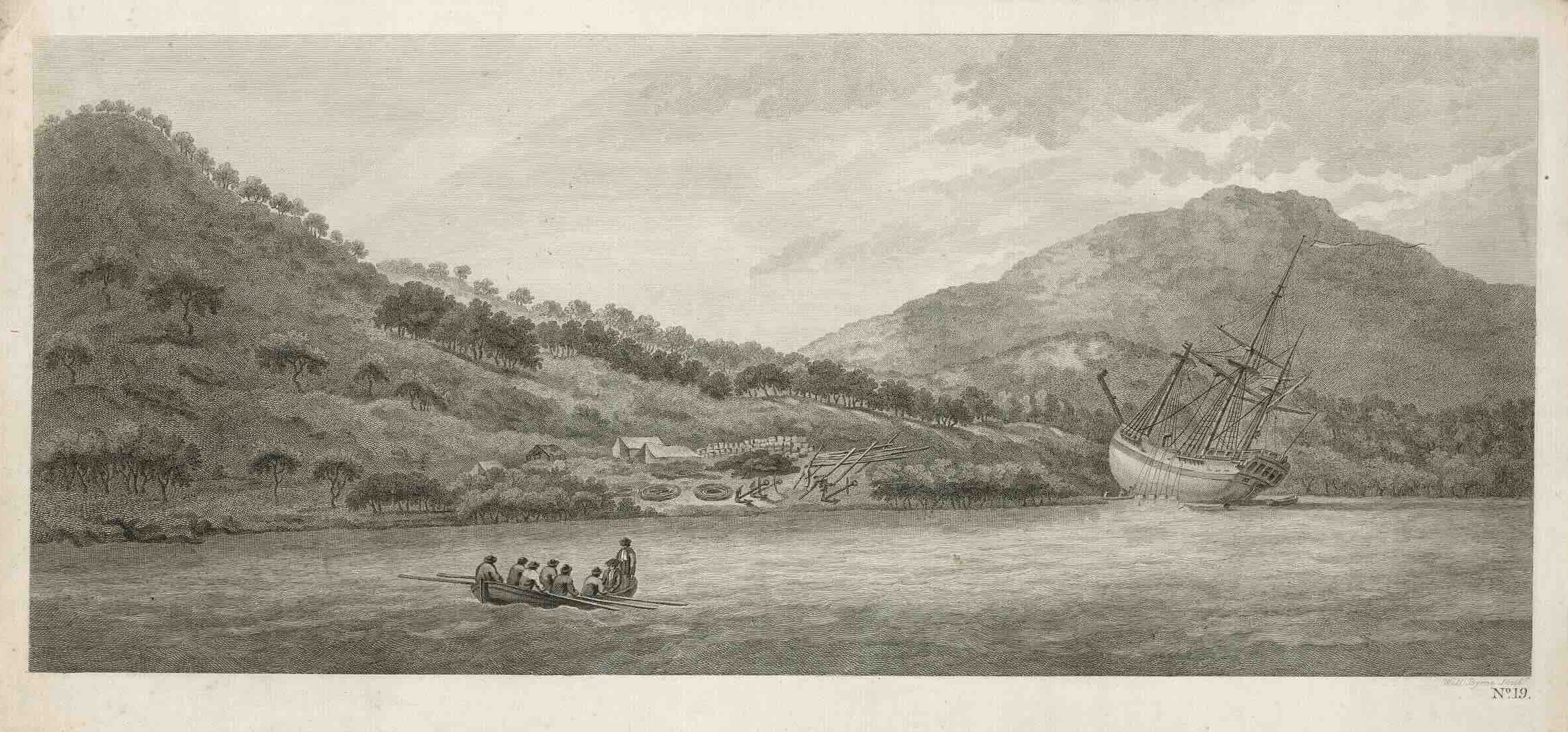
HMS Endeavour wrecked at Endeavour River, North Queensland. Engraving done after a lost drawing, likely by Sydney Parkinson in 1770. Cook gave this place the name Endeavour River in 1770 after his ship was damaged on the off-shore reef and needed repairs. Cook and crew stayed here for almost seven weeks and had contact with local Aboriginal people, the Guugu Yimithirr.
On June 11, when the Great Barrier Reef punched a hole in Endeavour’s side and held her in a death grip, Tupaia suffered along with the rest of the crew. Cook wrote that "this was an alarming and I may say terrible, circumstance and threatend immidiate destruction to us as soon as the Ship was afloat". Dumping 48 tons of material including cannons and stores, Cook famously managed to free the ship from the reef and limp to shore for repairs. Given his limited appetite for the shipboard diet, Tupaia developed scurvy, though it wasn’t acknowledged in Cook’s records where he claimed that he had kept his entire crew free of this deadly disease. Tupaia cured himself for a time by eating raw fish while the ship was beached at the Endeavour River.
After Tupaia was unsuccessful in his efforts to serve as a go-between and interpreter at Botany Bay with the cautious people of the land, he faded from view in the journals of Cook, Banks and others on Endeavour. We can speculate that he had lost his enthusiasm for the challenges of the journey which he had so bravely and creatively faced up to this point. He must have felt bitter, misunderstood, and dishonoured among what he knew to be these powerful yet ignorant strangers. He would have felt abandoned by his patron and friend Banks, as the young gentleman focused on preserving, describing, and pushing Parkinson to make more and more illustrations of the new plants that Banks and Solander had collected while botanizing in Australia.
With his ship in need of extensive repairs, Cook decided to make a run for the safety of the Dutch port of Batavia (modern Jakarta) in Indonesia. We know that enroute to Batavia Tupaia’s scurvy returned (his apprentice, the boy Taiata was also sick and weak). Though he knew he needed fresh fruit and fish to fight the disease, none was available to him. He refused to eat Cook’s prescribed diet which included some Vitamin C in the sauerkraut (though Cook was unaware of the vitamin’s efficacy). In Batavia Tupaia’s spirit revived somewhat. He was fascinated by the streets, houses and people in the lively port town, but under the surface it was a dangerous place to be. Banks wrote that “poor Tupias broken constitution felt it first and he grew worse and worse every day. Then Tayeto his boy was attackd by a cold and i[n]flammation on his lungs.”18
Scant references to him were hidden in plain sight in the original logs and journals, only to be pieced together by determined researchers in the late 20th century.
Nearly all the crew got sick in Batavia, including Banks, and the artist Sydney Parkinson was among the thirty members of Endeavour’s crew who eventually died from the illnesses they contracted there (7 in Batavia, 23 more in the 12 weeks after they sailed toward the Cape of Good Hope). Banks wrote in his journal of
the unhealthyness of the countrey, which much as I have said of it I believe I have not exagerated. The people themselves speak of it in as strong terms as I do, while the pale faces and diseasd bodies of those who are said to be inurd to it, as well as the preventive medicines etc. etc. and the frequent attacks of disease they are subject to, abundantly testifie to the truth of what they assert. The very church yards shew it by the number of graves constantly open in them, far disproportionate to the number of people.”19
At Tupaia’s request, Banks moved him from the ship to the seaman’s camp on Kuyper Island. “On the 28th I went down with him to Kuyper and on his liking the shore had a tent pitch'd for him in a place he chose where both sea breeze and land breeze blew right over him, a situation in which he expressd great satisfaction.” Then in November of 1770, first Taiata and the Tupaia succumbed to their infections. They died from a likely combination of amoebic dysentery, scurvy and perhaps also malaria which was endemic in the fetid waters of the port.
It is interesting to note in Banks’ journal at Batavia that, while briefly noting the death of his Polynesian companion ‘poor Tupia’, he devotes many pages to a discussion of the produce and riches of the region, as well as the variety and qualities of the Polynesian slaves in the market. He remarks on the high value of beautiful girls, and the temperaments of different ethnicities — the most troublesome are from Papua, the most faithful are from Bali — all presented as matters of fact without judgment.
Back in England, Cook would receive the Royal Society’s highest honour, the Copley Gold Medal, in recognition of his apparent conquest of scurvy. Though the well-known symptoms of scurvy would have been quite evident in Tupaia, Cook and others may have assumed that it was the dysentery that dissipated his enormous life force and killed him. Perhaps in the end an ‘Indian’ did not count. Some scholars have suggested that Cook’s brief comment on Tupaia’s life and death was unjust, failing to acknowledge his true stature and the service he had rendered: "He was a Shrewd, Sensible, Ingenious Man, but proud and obstinate which often made his situation on board both disagreeable to himself and those about him, and tended much to promote the deceases that put a period to his life."
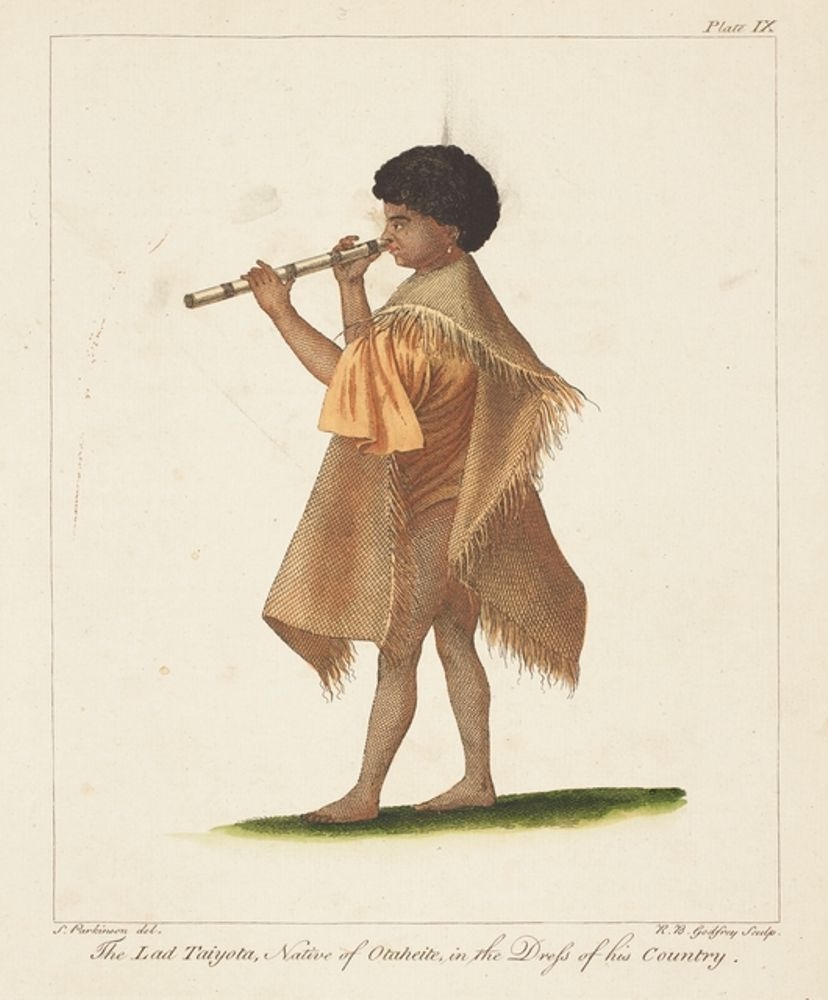
“The Child Taiyota, Native of Otaheite, in the Dress of his Country.” Taiata, Tupaia's apprentice, pictured in an engraving by R. B. Godfrey, based on a lost sketch by Sydney Parkinson.
When Cook returned to New Zealand in 1773 on his second voyage, the Māori came out from Tulaga Bay in their canoes, calling out the Tahitian’s name. These fierce warriors wept when they were told that Tupaia had died in Batavia. They sang ‘Aue, mate aue Tupaia’—‘Departed, dead, alas! Tupaia.’20
Cook and Banks returned home as heroes, but Tupaia and his work were overlooked and eventually forgotten. For 250 years he was an obscure footnote in one of Cook’s great stories. Scant references to him were hidden in plain sight in the original logs and journals, only to be recognized, pieced together and interpreted by determined researchers in the late 20th century. Fortunately his memory was never forgotten in the oral histories of the Māori of Aotearoa, where he continues to be celebrated and embraced in many ways including, with vivacious charm, on social media.
Cook’s complex legacy continues to command our attention, and we are fortunate that now a deeper understanding of Tupaia’s role on Endeavour can serve to complicate and enrich that legacy. Part three of this series will unravel Cook’s entanglement with, and narrow understanding of Polynesia on his third and final voyage. The imperial projects of possession, infection, conversion and imperfect assimilation — with violence to both people and nature — followed Cook everywhere he went. ≈ç
SEE PART 1 of this series, Captain Cook’s (Mis)adventures: 1. Cultural Exchange Through Objects.
NOTES
1 ‘Interview with Anne Salmond’ by Alan MacFarlane. November 19, 2004. YouTube.
2 Frame, William and Walker, Laura. James Cook: The Voyages. London: British Library 2018.
3 Dening, Greg. Mr Bligh’s Bad Language. New York: Cambridge University Press 1992.
4 Salmond, Samira with Anne Salmond. “Artefacts of Encounter.” Interdisciplinary Science Reviews, Vol. 35 No. 3–4, 2010, 302–1.
5 Dening, Mr Bligh’s.
6 Frame, James Cook.
7 Anne Salmond quoted in nhm.ac.uk/discover/on-tour-with-tupaia.
8 Dening, Mr Bligh’s.
9 Sahlins, Marshall. The New Science of the Enchanted Universe: An Anthropology of Most of Humanity. Princeton University Press: 2022.
10 O’Brien, Patrick. Joseph Banks: A Life. University of Chicago Press. Chicago: 1987.
11. Salmond, Anne. “Reimagining The Ocean”, “Oceania” exhibition catalogue, Royal Academy of Arts, London 2018.
12 Ibid.
13 Yarwood, Vaughan. New Zealand Geographic. https://www.nzgeo.com/stories/tupaia/ 2026. https://en.wikipedia.org/wiki/Tupaia_(navigator)
14 Salmond, ‘Reimagining.’
15 (wikipedia.org/wiki/Tupaia).
16 Salmond,“Artefacts of Encounter.”
17 Salmond, ‘Reimagining.’
18 (gutenberg.net.au/ebooks05/0501141h.html#batavia)
19 (gutenberg.net.au/ebooks05/0501141h.html#batavia).
20 Frame, James Cook.
REFERENCES
- Brunt, Peter and Thomas, Nicholas.“Oceania” exhibition catalogue, Royal Academy of Arts, London 2018.
- Dening, Greg. Mr Bligh’s Bad Language. New York: Cambridge University Press 1992.
- Druett, Joan . Tupaia: Captain Cook's Polynesian Navigator. Praeger Books, USA. 2010.
- Frame, William and Walker, Laura. James Cook: The Voyages. London: British Library 2018.
- Geiger, Jeffrey A. Facing the Pacific: Polynesia and the U.S. Imperial Imagination. University of Hawaii Press. Honolulu: 2007.
- Kushner, Rachel. Creation Lake. Scribner, New York: 2025.
- Moore, Peter. Endeavour: The Ship That Changed the World. New York: Picador 2018.
- O’Brien, Patrick. Joseph Banks: A Life. University of Chicago Press. Chicago: 1987.
- Sahlins, Marshall. The New Science of the Enchanted Universe: An Anthropology of Most of Humanity. Princeton University Press: 2022.
- Salmond, Anne. Aphrodite's Island: The European discovery of Tahiti. University of California Press. 2010.
- Salmond, Anne. “Reimagining The Ocean”, “Oceania” exhibition catalogue, Royal Academy of Arts, London 2018.
- Salmond, Anne. The Trial of The Cannibal Dog: Captain Cook in the South Seas. Allen Lane. 2003.
- Dame Anne Salmond interviewed by Alan Macfarlane, November 19, 2004.
- Salmond, Samira with Anne Salmond. “Artefacts of Encounter.” Interdisciplinary Science Reviews, Vol. 35 No. 3–4, 2010, 302–1.
- Sides, Hampton. The Wide Wide Sea: Imperial Ambition, First Contact and the Fateful Final Voyage of Captain James Cook. Penguin Random House, New York: 2024.
- Turnbull, David. “(En)countering Knowledge Traditions: The Story of Cook and Tupaia.” in Science, Empire and the European Exploration of the Pacific. London: Routledge 1994.
- Yarwood, Vaughan. New Zealand Geographic. https://www.nzgeo.com/stories/tupaia/ 2026.
- https://en.wikipedia.org/wiki/Tupaia_(navigator)
- https://Wikipedia.org/wiki/James_Cook
- https://www.nhm.ac.uk/discover/on-tour-with-tupaia.html
- https://www.captaincooksociety.com/cooks-voyages/first-pacific-voyage/t…
- https://teara.govt.nz/en/biographies/6t2/tupaia
- https://www.nzgeo.com/stories/tupaia/
- https://www.abc.net.au/news/2020-04-07/tupaia-star-navigator-helped-cap…

CHRIS LOWRY is a media producer and frequent contributor to the Journal of Wild Culture. His most recent award-winning documentary feature film is Rebel Angel (2022), about the Canadian cultural figures, Ross and Marion Woodman. He lives in Toronto where he performs regularly with his band, The Cool Blue North. View Chris' website.
IMAGE CREDITS. We thank the Trustees of the British Museum for the opportunity to use these images under our Creative Commons 4.0 International licence.
Add new comment